
How AI Wave Can Help Your Business
AI marketing platform that turns business goals into strategy, content, and results.

AI Wave Team

How AI Wave Can Help Your Business
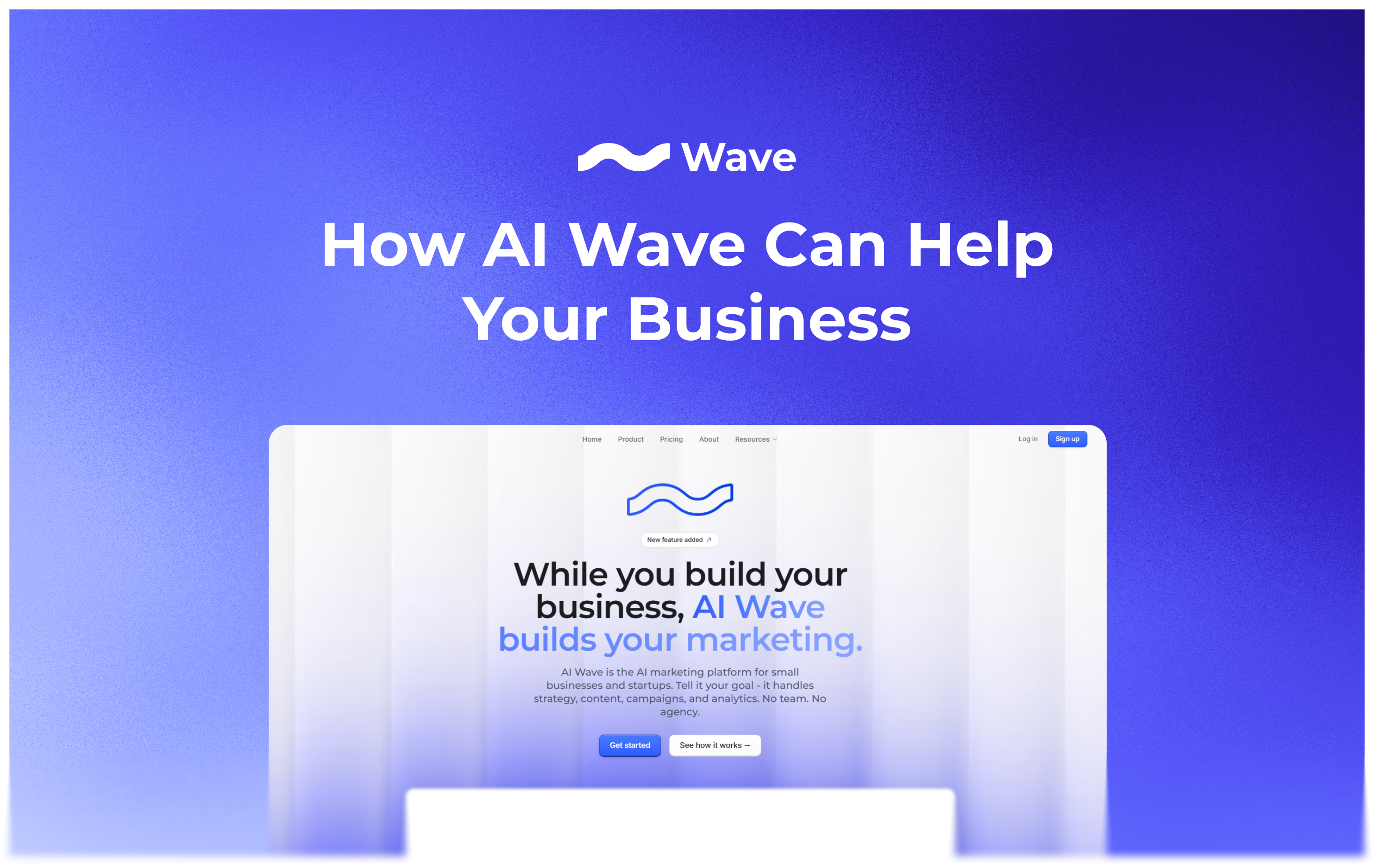
AI Wave is an AI marketing platform designed to help small businesses, startups, and growing teams run marketing in a more coordinated and manageable way. Instead of relying on separate tools for planning, content creation, publishing, and performance tracking, AI Wave brings those functions together in one workspace and structures them around a clear business goal. On the site, the product is presented as a system where you describe what you want to achieve, and the platform handles strategy, content, campaigns, and analytics as a coordinated process.
What AI Wave Does
At its core, AI Wave helps turn a business goal into real marketing execution. Rather than focusing on one isolated task, it is built to support the full workflow from planning to measurement. The website describes the product as an AI marketing platform that helps businesses move from a goal to strategy, content, publishing, and analytics, all inside a single environment. It also emphasizes that the product is meant to remove operational friction, so teams can stay focused on the business while marketing keeps moving.
This means AI Wave is not positioned as a simple content generator. It is meant to function more like an organized marketing system. A user can explain what they need in plain language, the way they would explain it to another person, and the platform translates that into a practical marketing workflow. According to the FAQ, users do not need prior marketing experience because AI Wave is designed to handle the strategic and operational translation for them.
The platform’s public messaging makes that distinction very clear. It does not claim to be just another generic AI tool that produces text on demand. Instead, it applies AI to the full marketing workflow, including planning, content creation, approvals, channel execution, and performance tracking. That broader scope is what defines its role inside a business.
How AI Wave Works
On the main site, AI Wave explains its workflow in three steps. First, the user tells the platform what they need in their own words. Second, the AI team works behind the scenes to build the strategy, create the content, design the visuals, and prepare the campaigns. Third, the user reviews the output, approves it, and then measures results once the work goes live. The site also states that nothing publishes without the user’s approval, which means the system is designed to speed up execution without removing control.
The same pages also explain that a typical first campaign can be drafted and ready for review in about 20 to 30 minutes, including strategy, content creation, and the first approval step. That gives a sense of how the product is intended to be used: not as a passive assistant, but as an active operational layer for marketing.
The AI Team Behind the Product
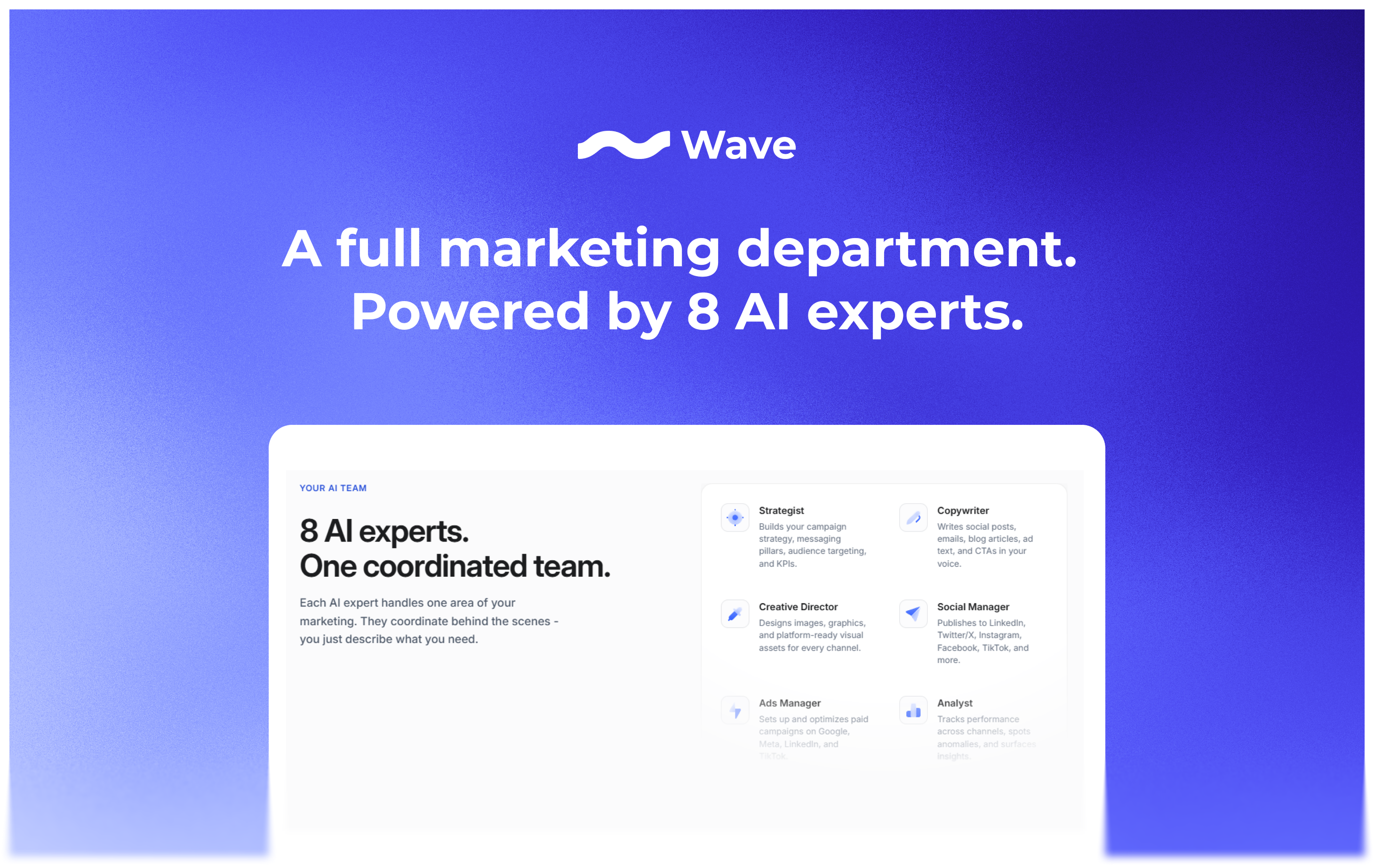
AI Wave presents itself as a full marketing department powered by 8 AI experts working together in one coordinated team. The public product page does not break down all twelve roles in detail, but it does clearly describe several core specialists and explains how they collaborate behind the scenes. The central idea is that each expert is responsible for one area of marketing, while the system as a whole stays aligned around the user’s goal.
The Strategist
The Strategist is responsible for building the foundation of a campaign. According to the product page, this role defines campaign strategy, messaging pillars, audience targeting, and KPIs. The site also explains that the Strategist analyzes the business, the audience, and the market, then creates a plan that includes channels, timelines, priorities, and measurable objectives. In practical terms, this role gives the rest of the system context and direction.
The Copywriter
The Copywriter handles the written side of execution. On the website, this role is described as the specialist who writes social posts, emails, blog articles, ad copy, and calls to action in the brand’s voice. This matters because AI Wave is not only trying to produce volume, but also consistency across channels and formats. The platform’s content section reinforces that idea by stating that content is created to sound like the business, not like generic AI output.
The Creative Director
The Creative Director is responsible for the visual layer. The product page states that this role designs images, graphics, and platform ready assets for each channel. That is an important part of the system because it means the product is built to support both messaging and presentation, rather than treating visuals as an afterthought. The site also notes that visual assets are designed in the brand’s style, which suggests that the platform is meant to keep execution consistent across both copy and design.
The Social Manager
The Social Manager takes care of social publishing across channels such as LinkedIn, X, Instagram, Facebook, TikTok, and others. The main site also mentions smart scheduling, explaining that AI Wave can choose the best time to publish and fill the calendar while leaving final approval to the user. This makes the Social Manager role more than a publishing utility. It becomes part of the broader coordination layer that keeps marketing moving on a regular basis.
The Ads Manager
The Ads Manager handles paid acquisition. On the product page, this role is described as the specialist who sets up and optimizes paid campaigns on Google, Meta, LinkedIn, and TikTok. This expands AI Wave beyond organic execution and makes it relevant for businesses that need both content and paid distribution inside the same system.
The Analyst
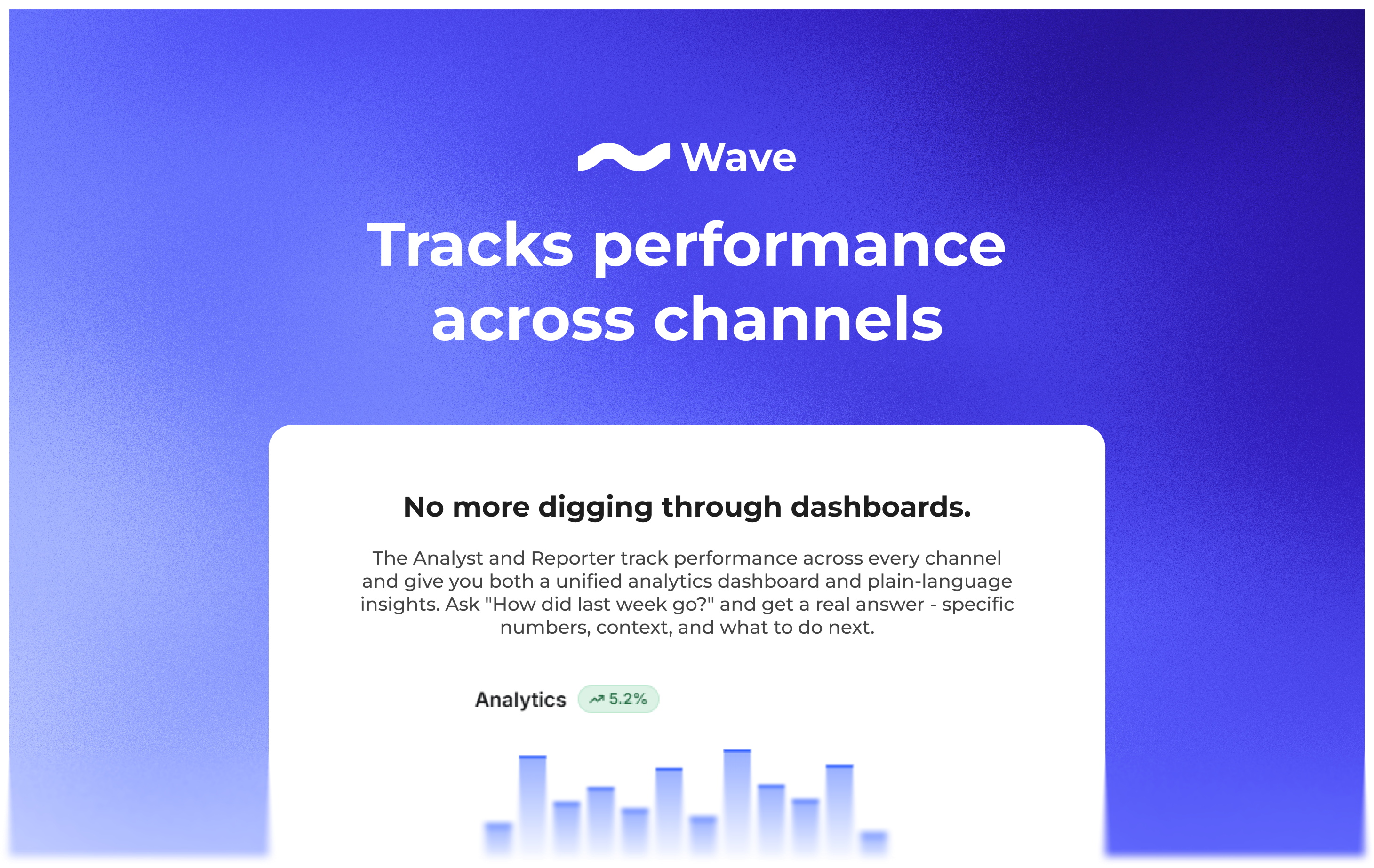
The Analyst is responsible for performance tracking and interpretation. According to the site, this role tracks performance across channels, spots anomalies, and surfaces insights. The analytics section adds that users can ask natural language questions on top of their data and receive plain language answers with specific numbers, context, and recommended next steps. This turns analytics into something more actionable and easier to use for non specialists.
Additional Specialists
The homepage also references an Email Marketer and notes that there are additional specialists behind the system. While the public site does not detail every role individually, it makes clear that the platform is structured as a coordinated team rather than a single model doing every job the same way. That team based architecture is central to how AI Wave presents itself.
The Main Advantages of AI Wave
One of the clearest advantages of AI Wave is coordination. Instead of splitting planning, content, publishing, and reporting across several disconnected tools, the product brings those functions together in one workspace. That reduces context switching and helps marketing feel like a connected process rather than a set of unrelated tasks.
Another advantage is accessibility. The platform is built so users can simply describe what they want in plain language. The site explicitly says that no marketing knowledge is required and that the system is designed to remove the learning curve rather than add to it. For founders and small teams, that matters because it lowers the operational barrier to getting started.
AI Wave also offers continuity across the workflow. Many AI tools stop at generating one output, but the site positions AI Wave as a system that continues through approvals, channel execution, and performance tracking. That means users are not left with a draft and a separate pile of manual work. Instead, the product is meant to support the full path from planning to review and measurement.
Control is another important advantage. The site makes it clear that nothing is published without explicit approval, so the user stays in charge of what reaches the audience. This gives businesses a way to move faster without giving up oversight of tone, messaging, or timing.
Finally, AI Wave is built to work across multiple channels. The site references connected channels and shows support across social, content, ads, and analytics. That multi channel structure is what makes the product more useful as a real operating layer for marketing, rather than a single purpose assistant.
What Makes AI Wave Different
A recurring theme across the website is that AI Wave is not meant to replace one copywriting tool with another. The company positions it as a complete marketing workflow system. In the FAQ, the difference is described directly: generic AI tools generate text when prompted, while AI Wave applies AI to planning, content creation, approvals, channel execution, and performance tracking. That distinction is key to understanding the product.
This also explains why the platform focuses so heavily on coordinated specialists. The value is not just in having an AI write something quickly. The value is in connecting strategic thinking, production, execution, and analysis so that the whole workflow becomes easier to manage.

The Story Behind AI Wave
The About page explains that AI Wave was built in Barcelona by Albert Obelleiro and Joel Rodriguez. Their starting point was a recurring problem: many small companies build strong products but never solve marketing, not because they do not care, but because they lack the team, time, or budget to do it properly. The site says the tools they saw in the market could write a post or generate an image, but they still left users with the harder work of deciding strategy, formatting everything, scheduling it, publishing it, and checking multiple dashboards afterward.
That is why the founders describe AI Wave as the system they could not find. Their goal was to build the entire process as one coordinated system, from strategy to publishing, measurement, and recommendations. The About page presents this as the core mission of the company: making real marketing accessible to every business.
The site describes Albert Obelleiro as Founder and Product Architect, focused on giving businesses access to a marketing team that thinks strategically, executes across channels, and learns from results. Joel Rodriguez is presented as Co Founder and Growth Strategist, bringing the commercial perspective that helps turn marketing from a cost center into a growth engine. The company states that its roots are in Barcelona and that the team works remotely.
Ready to stop reading and start doing?
AI Wave turns these strategies into action, for your business, across your channels.